
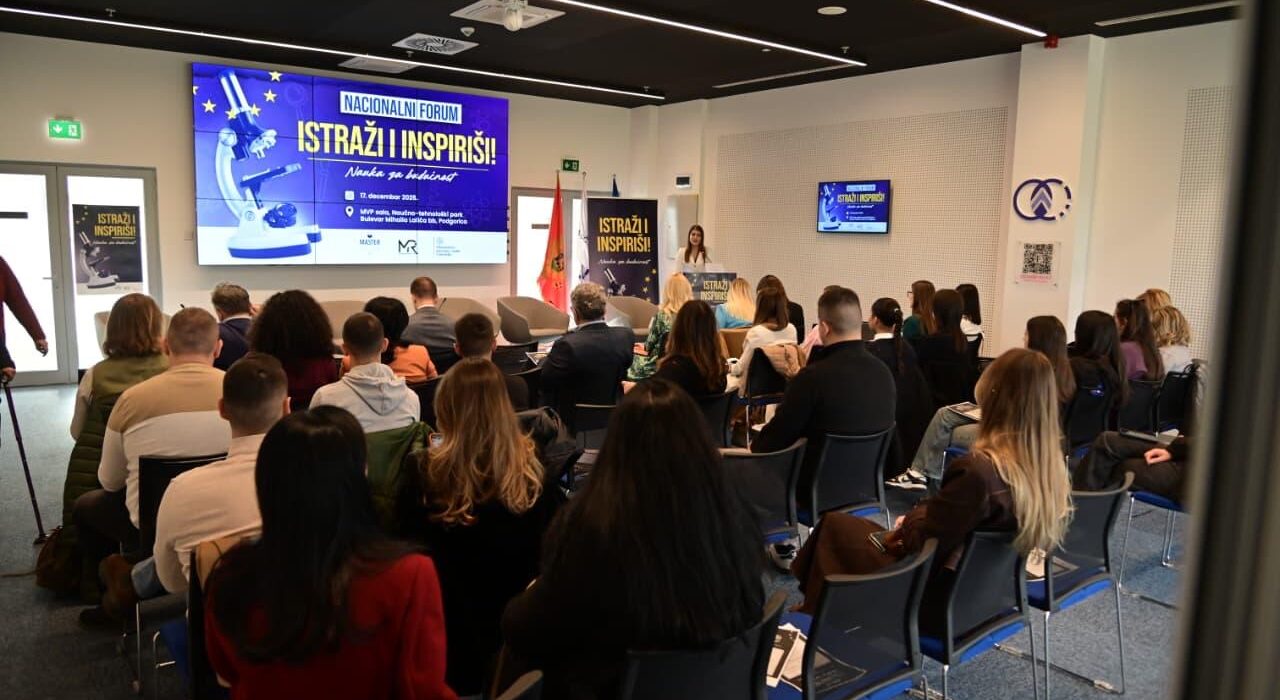
The National Forum “Science for the Future” was held at the Science and Technology Park in Podgorica, marking the final event of the project “Explore and Inspire: Science for the Future,” which the Network for European Policies – MASTER implemented over the past 12 months in partnership with Montenegro Robotics, with the support of the Ministry of Education, Science and Innovation.
The significance of the Forum lies in the fact that it brought together, in one place, the key results of the project, findings from the conducted research, experiences of young researchers, and perspectives of relevant stakeholders from institutions, academia, and the civil sector. The Forum was designed as a space for dialogue and interaction between young people interested in science—who represent the project’s primary target group—and decision-makers and experts, with the aim of strengthening communication and encouraging joint reflection on the future of science in Montenegro.
The Forum was opened with introductory remarks by Ms. Andrea Popović, Executive Director of the Network for European Policies – MASTER, who emphasized the importance of retaining young researchers in Montenegro and positioning science as the foundation of all public policies and decision-making.
During the event, the results of the research and the project itself were presented, along with a documentary film produced as part of the project. As a reminder, within the project “Explore and Inspire: Science for the Future,” a comprehensive study on the state and challenges of science in Montenegro was conducted, forming the basis for a thematic publication that also includes examples of good practices from EU Member States. Additionally, a three-day Science Camp was organized in Plužine for young people from different parts of Montenegro, five podcast episodes dedicated to science and youth were produced and published, and a documentary film was created, authentically portraying the experiences of researchers and the potential of science as a driver of social change.
The central part of the Forum was a panel discussion that gathered distinguished experts and representatives of the academic and scientific research community.
Academician Dr. Predrag Miranović from the Montenegrin Academy of Sciences and Arts spoke about the role of national scientific institutions in recognizing and supporting young talent, emphasizing that the connections young researchers build throughout their careers are extremely important, both in Montenegro and globally, and noting that it is natural for the best to go where opportunities are greatest.
Dr. Zoran Dabetić, State Secretary at the Ministry of Ecology, Sustainable Development and Northern Development, highlighted the importance of basing public policies on scientific evidence, noting that while this should be the case in Montenegro, a more strategic approach is still needed. Nevertheless, he remains optimistic about the country’s potential.
Dr. Milica Vukotić, Vice-Rector of the University of Donja Gorica, pointed to the need for stronger cooperation between public and private universities, emphasizing that Montenegro is too small for divisions and that isolation in science prevents meaningful change.
Prof. Dr. Radovan Stojanović from the Faculty of Electrical Engineering at the University of Montenegro stressed the importance of modernizing educational programs and keeping pace with technological trends, noting that while progress has been made, there is still a need to establish institutes and research centers, and that professors must act as mentors who evolve with the times.
Mr. Ivan Martinović, recipient of the award for the best scientific research paper in the field of artificial intelligence, spoke about the importance of informal initiatives and innovative approaches in the development of young researchers, emphasizing that these are crucial for advancing Montenegro’s research landscape, and that focus must be placed on improving the quality—not just the quantity—of opportunities for young people.
The Network for European Policies – MASTER will continue its ongoing work to strengthen the capacities of young people, enhance dialogue between the scientific community and decision-makers, and support the development of a high-quality and sustainable scientific research system in Montenegro, with the firm belief that investing in science means investing in the future of society as a whole.