
The Network for European Policies – MASTER has published the policy paper “Is ‘School in Nature’ Really School in Nature?”, with the aim of determining—based on data and systemic analysis—the extent to which the “school in nature” program in Montenegro is implemented in line with its educational purpose and principles of public interest. The document was developed within the project “Corruption in Education”, with the support of the Balkan Investigative Reporting Network (BIRN) and the Civic Alliance.

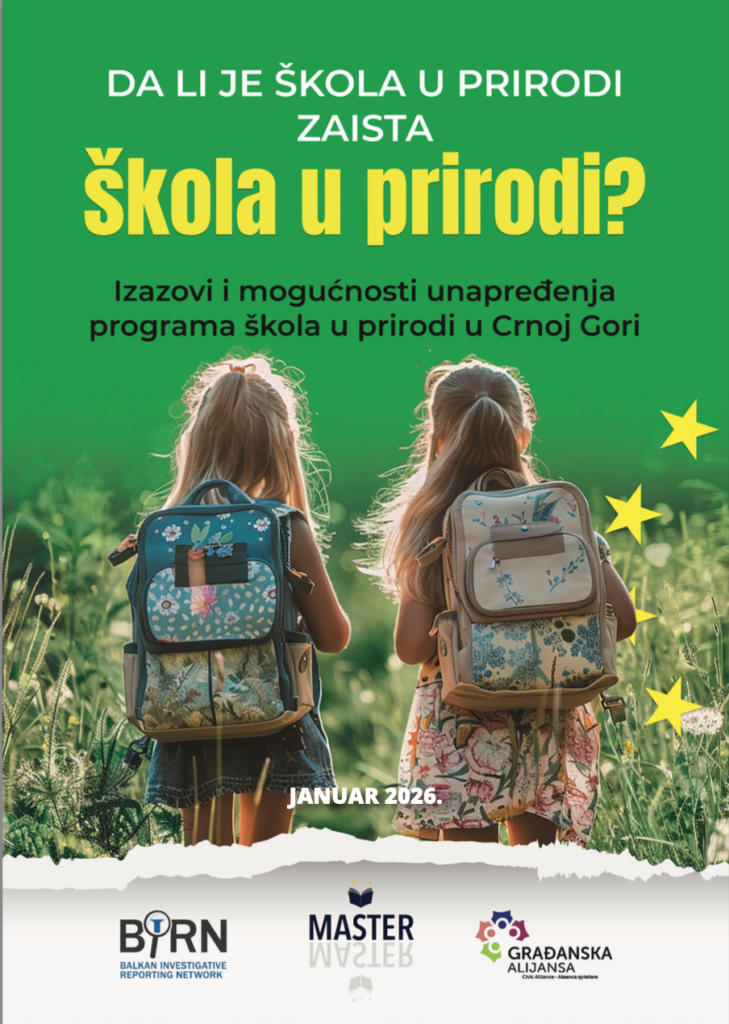
The Network for European Policies – MASTER has published the policy paper “Is ‘School in Nature’ Really School in Nature?”, with the aim of determining—based on data and systemic analysis—the extent to which the “school in nature” program in Montenegro is implemented in line with its educational purpose and principles of public interest. The document was developed within the project “Corruption in Education”, with the support of the Balkan Investigative Reporting Network (BIRN) and the Civic Alliance.
The policy paper is based on research involving more than 800 parents, teachers, education and ecology experts, as well as school representatives. The research included an online survey, focus groups, analysis of the normative and institutional framework, and documentation obtained through requests for free access to information.
The findings show a significant discrepancy between the formal definition of “school in nature” as part of the educational process and the way the program is implemented in practice.
Survey results indicate that only 13.9% of respondents believe that activities were fully aligned with the curriculum, while 38.4% report weak or no connection.
“Only 13.5% believe the program significantly contributes to education, while 44% assess its contribution as small or non-existent. Programs are predominantly implemented in hotel accommodation: 53.6% in 2–3 star hotels, 32.3% in 4–5 star hotels, while only 6.1% take place in lodges, mountain facilities, or camps,” the research states.
Nearly a quarter of respondents (23.7%) report that activities were mostly or not at all organized in a natural environment.
The research shows that “schools in nature” are predominantly carried out in hotel settings, with limited time spent outdoors, reducing the concept of experiential learning to a minimum. “If nature is not the central educational resource, but merely a supporting element of the program, then it is necessary to question the essence and purpose of this model,” MASTER representatives state.
One of the strongest findings relates to the perception of program costs.
More than half of respondents (58.4%) consider the price too high in relation to living standards and the quality of content, while 29.1% assess it as moderately high.
Prices for a four-day stay range from €200 to €250 per student, with significant variations even within the same municipalities (e.g., €190–€230 for similar conditions), without clearly defined criteria.
There is no obligation to obtain multiple offers, so schools often rely on a single travel agency. Parents have limited insight into contracts (23.7% have seen them, 24.8% have not, and 35.7% have no information), cost structures, and selection criteria.
A significant number of primary schools do not implement the program at all due to financial and organizational barriers, further deepening inequalities among students. 45.9% of respondents believe that “school in nature” is not equally accessible to all children.
Particularly concerning is the existence of notable and difficult-to-explain price differences between schools—including those within the same municipality or immediate geographic proximity. The analysis shows that for a similar number of days, comparable accommodation conditions, and similar program content, prices can vary by several tens of euros per child, without clearly defined criteria to justify such differences.
The findings indicate that, in practice, there is no obligation to obtain multiple offers for organizing “school in nature,” which often leaves schools with only one available option. At the same time, parents have limited insight into the criteria for selecting organizers, cost structures, and contract content.
The research also shows that a significant number of primary schools do not implement the program at all, most often due to financial constraints and organizational challenges, further increasing disparities among students.
“In the absence of clear standards, ‘school in nature’ does not function as a unified public program, but rather as a set of uneven practices dependent on local circumstances and the financial capacity of parents,” MASTER states.
Although examples of quality implementation have been identified, they are the result of individual initiative and personal commitment, rather than a stable and binding systemic solution.
The policy paper concludes that the current model of “school in nature” operates between an educational obligation and an unregulated market practice, without clearly defined responsibilities, binding standards, or a sustainable financial framework.
Continuing the program without clear reform carries the risk of further distancing it from its educational purpose, deepening social inequalities among children, and weakening public trust in the education system.
“‘School in nature’ must be part of public education policy, with clear rules, equal conditions, and measurable educational outcomes—not a space of inconsistent market practices,” MASTER concludes