
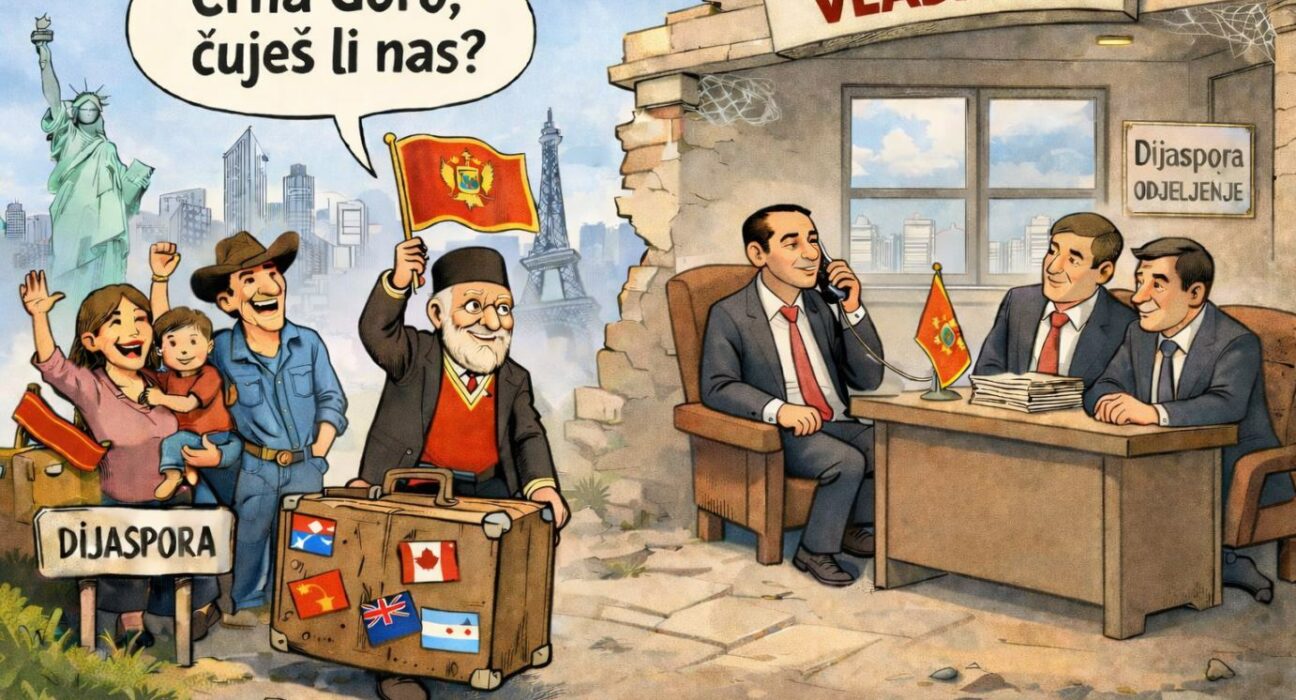
Emigrants gathered in communities endlessly repeat the same stories, which in that way become unforgettable. However, those who do not associate with compatriots, like Irena or Odysseus, inevitably fall under the sway of forgetting. The stronger their nostalgia, the fewer memories it contains. The more Odysseus longed, the more he forgot. For nostalgia does not stimulate the work of memory, it does not awaken recollections—it is self-sufficient, wholly surrendered to its own feeling, to suffering itself.
— Milan Kundera, “Ignorance”

–
— Milan Kundera, “Ignorance”
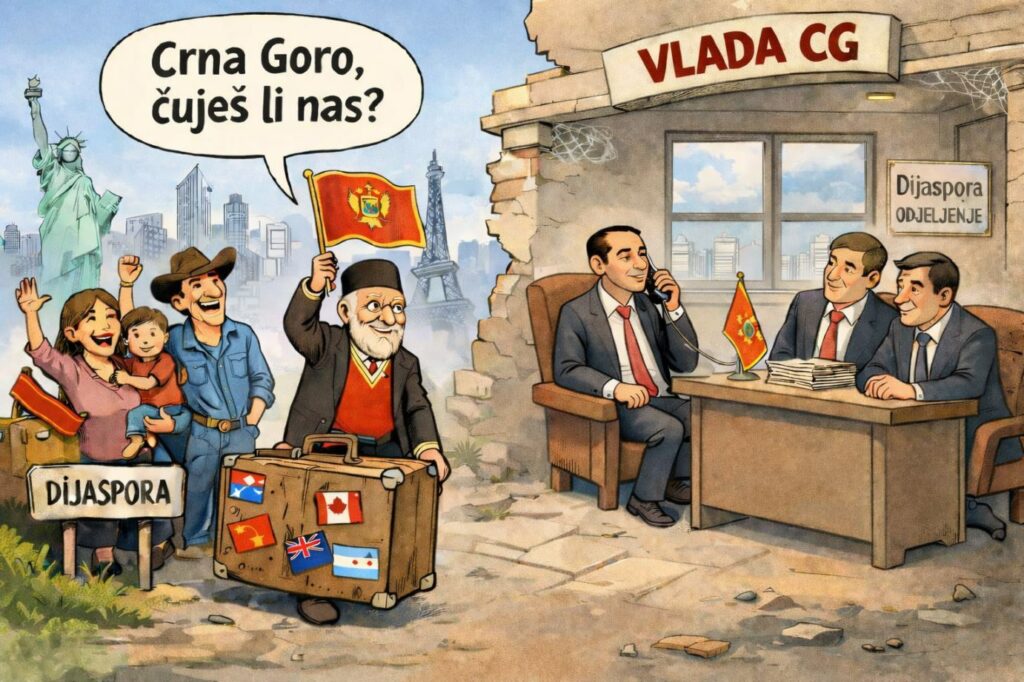
Although at first glance this quote may seem unsuitable for a reflection and critical examination of a state’s policy, a deeper analysis reveals that it actually reflects the cultural and realpolitik aspects of the relationship between a state and its diaspora. Emotional attachment to the place of origin, often transmitted from generation to generation, forms the basis for the creation of a strong political sentiment, as well as a potential political relationship which, if strategically directed, can benefit both emigrants and their country of origin.
Montenegro, a country with just 623,000 inhabitants, according to estimates by the Society of Statisticians and Demographers of Montenegro and the International Organization for Migration, has a proportionally large diaspora, estimated at between 200,000 and 600,000 emigrants of Montenegrin origin. The largest numbers of emigrants are found in Argentina, Serbia, the United States, Turkey, Switzerland, Luxembourg, and Germany. Despite this potential, the institutionalization of relations between Montenegro and its diaspora has been slow and long outside political priorities.
Efforts toward institutional inclusion of the diaspora began in 2002 with the establishment of the Centre for Emigrants within the Ministry of Foreign Affairs, which resulted in the adoption of the first Strategy for Cooperation with the Diaspora (2011–2014) and the transformation of the Centre into the Directorate for Diaspora in 2013. The Law on Cooperation with the Diaspora was adopted in 2015 and amended in 2018 and 2019, when the Directorate became an independent body outside the Ministry. It was only in 2023 that a Ministry of Diaspora was established for the first time. Although some progress has been made in cooperation with the scientific diaspora through strategic documents and programs in education, science, and innovation, there has been no substantial breakthrough in strengthening ties with the broader diaspora.
As an illustrative example of the long-term consequences of an insufficiently responsible systemic relationship between the state and its diaspora, one can point to the case of the Montenegrin diaspora in Argentina. Montenegrins began arriving there in significant numbers in the late 19th and early 20th centuries, primarily settling in rural areas, with a settlement symbolically named La Montenegrina formed in the Chaco province.
However, due to turbulent political and historical changes in their country of origin—whose consequences persist even today—as well as the lack of continuous institutional support and the pronounced influence of the Serbian Orthodox Church, the identity of this community has become increasingly ambiguous over time. Research by B. Pantović and M. Stefanović-Banović, based on interviews with members of this group, indicates that only a small percentage of descendants of emigrants—especially from second and later generations—have a clear understanding of the language they speak. In everyday communication, identity is often expressed through vague categories such as “our language” or “our people.”
Such confusion does not arise solely as a result of the natural intertwining of identities, but rather from continuous political neglect of the Montenegrin diaspora as a whole. The Montenegrin diaspora belongs to a type characterized by a complex identity, most strongly expressed through attachment to place—that is, to the state of Montenegro—as well as its culture. Despite this, attachment to Montenegro persists, primarily through symbolic and cultural patterns, as evidenced by the fact that most respondents visit Montenegro at least once, while objects such as the gusle or traditional Montenegrin costumes are often preserved in private spaces.
Culture, beyond being a component of identity, also represents a powerful instrument of soft power—non-coercive political influence. It is precisely in this segment that Montenegro’s foreign policy shows limitations, as communities that should be under its strongest influence are left to preserve cultural patterns independently, through cultural associations and informal networks. This contributes to the gradual erosion of the linguistic and national identity of the diaspora.
In the coming period, Montenegro will need to place culture at the center of its diaspora policies, while understanding the contemporary social context shaped by globalization and digital transformation. In such a context, the very way culture is “consumed” has changed—it is no longer merely aesthetic enjoyment or passive inheritance, but a field of active participation in its creation, reinterpretation, and preservation.
In this sense, the state should not treat diaspora members merely as recipients of culture, but as co-creators of Montenegro’s cultural identity in a transnational space. In this way, what was mentioned at the beginning as a moral responsibility based on emotional attachment could be established as the foundation for a long-term and sustainable relationship between Montenegro and its diaspora. Understood in this way, culture becomes a key instrument of political and social connection.
Establishing a two-way relationship between the state apparatus—led by the Ministry of Diaspora—and the diaspora, in which culture acts as a connecting political mechanism, could spill over into areas of economic and institutional cooperation. Through trust and a sense of belonging, favorable conditions could be created for diaspora direct investment, providing an additional source of capital that would enhance the competitiveness of the domestic market. This form of financial cooperation would be particularly important in the context of Montenegro’s accession to the European Union market, where resilience and diversification (not relying solely on tourism) will be key prerequisites for success. On the other hand, the state would be responsible for creating a favorable investment environment through regulatory, fiscal, and institutional mechanisms.
Beyond its economic potential, the diaspora also represents a significant reservoir of social capital, particularly in areas such as knowledge transfer, professionalization, and the strengthening of democratic institutions. Its contribution therefore goes beyond the financial dimension and becomes structurally important for Montenegro’s long-term development.
For a good example of utilizing diaspora social capital, one need not look further than neighboring Albania. The proposal by Prime Minister Edi Rama to accelerate Albania’s EU accession process—suggesting that Albania might not initially have full voting rights but instead be represented by Italy—appears far more politically calculated than it may seem at first glance. It is estimated that over 200,000 members of the Albanian diaspora live in Italy, which has kept the two countries in close diplomatic relations for decades. This suggests that when Rama speaks of representation, he is also considering the strong influence of the Albanian diaspora in Italy.
Finally, it is important to note that this text does not seek to offer definitive solutions, nor to map the many complex dimensions of the relationship between Montenegro and its diaspora. Its intention is more modest: to point to the long-standing neglect of a segment of Montenegro’s political and cultural identity. Precisely in this incompleteness and theoretical imperfection lies its greatest value, as it reflects the real state of affairs while leaving space for further academic and public discussion.
Author: Danijel Karađinović, MASTER
[1] Williams, Nick. “Mobilising diaspora to promote homeland investment: The progress of policy in post-conflict economies.” Environment and Planning C: Politics and Space 36.7 (2018): 1256-1279.
[2] Vukićević, Jasna. “Crna Gora ne zna kolika joj je dijaspora.” Radio Slobodna Evropa, 2 Dec. 2024,
www.slobodnaevropa.org/a/cnra-gora-registar-dijaspore/33223381.html
[3] European Centre for Social Welfare Policy and Research.2018. EEPOW Posting of Workers in Eastern Europe. Country Report for Montenegro https://www.euro.centre.org/downloads/detail/3411;. Analytical Study of Montenegrin Diaspora, 2014. p.3. https://wbcrti.info/object/document/14654/attach/Study_of_Montenegrin_Scientific_Diaspora.pdf
[4] “Compendium on Best Practices in DIASPORA ENGAGEMENT in the Western Balkans.” Regional Cooperation Council, 28 Oct. 2022, www.rcc.int/pubs/148/compendium-on-best-practices-in-diaspora-engagement-in-the-western-balkans
[5] Ibid.
[6] Stefanović-Banović, Milesa, and Branislav Pantović. “‘Our’diaspora in Argentina: Historical overview and preliminary research.” Glasnik Etnografskog instituta SANU 61.1 (2013): 119-131.
[7] Ibid.
[8] Voicu, Cristina-Georgiana. “Cultural identity and diaspora.” Philobiblon 18.1 (2013)
[9] Stefanović-Banović, Milesa, and Branislav Pantović. “‘Our’diaspora in Argentina: Historical overview and preliminary research.” Glasnik Etnografskog instituta SANU 61.1 (2013): 119-131
[10] Crna Gora uklesana u Argentini, RTCG (Radio Televizija Crne Gore), objavljeno 1. decembra 2025, https://rtcg.me/vijesti/dijaspora/784902/crna-gora-uklesana-u‑argentini.htm
[11] Vrbek, Sanja, and Irene Pluchinotta. “Is Culture a Special’Hub’Policy Area for Co-Creation?.” Journal of Comparative Politics 14.2 (2021): 34-52.
[12] Williams, Nick. “Mobilising diaspora to promote homeland investment: The progress of policy in post-conflict economies.” Environment and Planning C: Politics and Space 36.7 (2018): 1256-1279.
[13] Ibid.
[14] “Spremni smo na članstvo bez prava glasa i da nas zastupa Italija”: Menja li Rama suverenitet za članstvo u EU? Euronews Srbija, 24. novembar 2025, https://www.euronews.rs/evropa/vesti/198163/menja-li-rama-suverenitet-za-clanstvo-u-eu/vest